Part 1
요약·해설
지원표 2행, 전체 module 사양과 SW4/SW5 전환, hci_uart·observer·debug 명령을 보존했습니다.
SiP-LGA86
up to 75m
LPUART1
B-U585I-IOT02A
Part 2
접을 수 있는 영어 원문 전체
영어 원문 전체 펼치기
713844C2D28AB8F7269197E4EDB8A5175DBC8136F84E97B443C92CB61ED10D4D
.. _stm32wb5mmg_bluetooth_module:

ST STM32WB5MMG
################

Overview
********

STM32WB5MMG is an ultra-low-power and small form factor certified 2.4 GHz
wireless module. It supports Bluetooth|reg| Low Energy 5.4, Zigbee|reg| 3.0,
OpenThread, dynamic, and static concurrent modes, and 802.15.4 proprietary
protocols. This board support is added in order to make it possible use this
module on other boards as HCI layer (Specefically B-U585I-IOT02A Development board).

STM32WB5MMG supports the following features:

- Bluetooth module in SiP-LGA86 package
- Integrated chip antenna
- Bluetooth|reg| Low Energy 5.4, Zigbee|reg| 3.0, OpenThread certified
  Dynamic and static concurrent modes
- IEEE 802.15.4-2011 MAC PHY Supports 2 Mbits/s
- Frequency band 2402-2480 MHz
- Advertising extension
- Tx output power up to +6 dBm
- Rx sensitivity: -96 dBm (Bluetooth|reg| Low Energy at 1 Mbps), -100 dBm (802.15.4)
- Range: up to 75 meters
- Dedicated Arm|reg| Cortex|reg|-M0+ CPU for radio and security tasks
- Dedicated Arm|reg| Cortex|reg|-M4 CPU with FPU and ART (adaptive real-time accelerator) up to 64 MHz speed
- 1-Mbyte flash memory, 256-Kbyte SRAM
- Fully integrated BOM, including 32 MHz radio and 32 kHz RTC crystals
- Integrated SMPS
- Ultra-low-power modes for battery longevity
- 68 GPIOs
- SWD, JTAG

.. image:: ../../../../../../../boards/st/stm32wb5mmg/doc/img/STM32WB5MMG.jpg
   :align: center
   :alt: STM32WB5MMG

More information about the board can be found at the `` `STM32WB5MMG on www.st.com`_.

Hardware
********

STM32WB5MMG is an ultra-low-power and small form factor certified 2.4 GHz
wireless module. It supportsBluetooth|reg| Low Energy 5.4, Zigbee|reg| 3.0, OpenThread,
dynamic, and static concurrent modes, and 802.15.4proprietary protocols. Based
on the STMicroelectronics STM32WB55VGY wireless microcontroller,STM32WB5MMG
provides best-in-class RF performance thanks to its high receiver sensitivity
and output power signal. Its low-power features enable extended battery life,
small coin-cell batteries, and energy harvesting. STM32WB5MMG revision Y is
based on cut 2.1 of the STM32WB55VGY microcontroller. Revision X is based on
cut 2.2.

- Ultra-low-power with FlexPowerControl (down to 600 nA Standby mode with RTC and 32KB RAM)
- Core: ARM |reg| 32-bit Cortex |reg|-M4 CPU with FPU, frequency up to 64 MHz
- Radio:

  - 2.4GHz
  - RF transceiver supporting Bluetooth|reg| 5.4
    specification, IEEE 802.15.4-2011 PHY
    and MAC, supporting Thread 1.3 and
  - Zigbee|reg| 3.0
  - RX sensitivity: -96 dBm (Bluetooth |reg| Low
    Energy at 1 Mbps), -100 dBm (802.15.4)
  - Programmable output power up to +6 dBm
    with 1 dB steps
  - Integrated balun to reduce BOM
  - Support for 2 Mbps
  - Support GATT caching
  - Support EATT (enhanced ATT)
  - Support advertising extension
  - Dedicated Arm|reg| 32-bit Cortex|reg| M0+ CPU
    for real-time Radio layer
  - Accurate RSSI to enable power control
  - Suitable for systems requiring compliance
    with radio frequency regulations ETSI EN
    300 328, EN 300 440, FCC CFR47 Part 15
    and ARIB STD-T66


- Clock Sources:

  - 32 MHz crystal oscillator with integrated
    trimming capacitors (Radio and CPU clock)
  - 32 kHz crystal oscillator for RTC (LSE)
  - Internal low-power 32 kHz (±5%) RC (LSI1)
  - Internal low-power 32 kHz (stability
    ±500 ppm) RC (LSI2)
  - Internal multispeed 100 kHz to 48 MHz
    oscillator, auto-trimmed by LSE (better than
    ±0.25% accuracy)
  - High speed internal 16 MHz factory
    trimmed RC (±1%)
  - 2x PLL for system clock, USB, SAI, ADC

- 2x DMA controllers (seven channels each) supporting ADC, SPI, I2C, USART, QSPI, SAI, AES, timers
- 1x USART (ISO 7816, IrDA, SPI master, Modbus and Smartcard mode)
- 1x LPUART (low power)
- Two SPI running at 32 Mbit/s
- 2x I2C (SMBus/PMBus)
- 1x SAI (dual channel high quality audio)
- 1x USB 2.0 FS device, crystal-less, BCD and LPM
- 1x Touch sensing controller, up to 18 sensors
- 1x LCD 8x40 with step-up converter
- 1x 16-bit, four channels advanced timer
- 2x 16-bit, two channels timers
- 1x 32-bit, four channels timer
- 2x 16-bit ultra-low-power timers
- 1x independent Systick
- 1x independent watchdog
- 1x window watchdog
- Up to 72 fast I/Os, 70 of them 5 V-tolerant

- Memories

  - Up to 1 MB flash memory with sector
    protection (PCROP) against R/W
    operations, enabling radio stack and
    application
  - Up to 256 KB SRAM, including 64 KB with
    hardware parity check
  - 20x 32-bit backup register
  - Boot loader supporting USART, SPI, I2C
    and USB interfaces
  - OTA (over the air) Bluetooth® Low Energy
    and 802.15.4 update
  - Quad SPI memory interface with XIP
  - 1 Kbyte (128 double words) OTP

- 4x digital filters for sigma delta modulator
- Rich analog peripherals (down to 1.62 V)

- 12-bit ADC 4.26 Msps, up to 16-bit with
  hardware oversampling, 200 μA/Msps
- 2x ultra-low-power comparator
- Accurate 2.5 V or 2.048 V reference
  voltage buffered output


- Security and ID

 - Secure firmware installation (SFI) for
   Bluetooth|reg| Low Energy and 802.15.4 SW stack
 - 3x hardware encryption AES maximum 256-bit for
   the application, the Bluetooth|reg|
 - Low Energy and IEEE802.15.4
 - Customer key storage/manager services
 - HW public key authority (PKA)
 - Cryptographic algorithms: RSA, Diffie-Helman, ECC over GF(p)
 - True random number generator (RNG)
 - Sector protection against R/W operation (PCROP)
 - CRC calculation unit
 - Die information: 96-bit unique ID
 - IEEE 64-bit unique ID, possibility to derive 802.15.4 64-bit
   and Bluetooth|reg| Low Energy
 - 48-bit EUI

More information about STM32WB55RG can be found here:

- `STM32WB5MMG on www.st.com`_
- `STM32WB5MMG datasheet`_

Supported Features
==================

The Zephyr STM32WB5MMG board configuration supports the following hardware features:

+-----------+------------+-------------------------------------+
| Interface | Controller | Driver/Component                    |
+===========+============+=====================================+
| UART      | on-chip    | serial port-polling;                |
|           |            | serial port-interrupt               |
+-----------+------------+-------------------------------------+
| RADIO     | on-chip    | Bluetooth Low Energy                |
+-----------+------------+-------------------------------------+


Other hardware features are not yet supported on this Zephyr port.

The default configuration can be found in the defconfig file:
:zephyr_file:`boards/st/stm32wb5mmg/stm32wb5mmg_defconfig`

Bluetooth and compatibility with STM32WB Copro Wireless Binaries
================================================================

To operate bluetooth on STM32WB5MMG, Cortex-M0 core should be flashed with
a valid STM32WB Coprocessor binaries (either 'Full stack' or 'HCI Layer').
These binaries are delivered in STM32WB Cube packages, under
Projects/STM32WB_Copro_Wireless_Binaries/STM32WB5x/
For compatibility information with the various versions of these binaries,
please check `modules/hal/stm32/lib/stm32wb/hci/README`_
in the hal_stm32 repo.
Note that since STM32WB Cube package V1.13.2, "full stack" binaries are not compatible
anymore for a use in Zephyr and only "HCI Only" versions should be used on the M0
side.

Connections and IOs
===================


Default Zephyr Peripheral Mapping:
----------------------------------

.. rst-class:: rst-columns

- UART_1 TX/RX : PB7/PB6
- LPUART_1 TX/RX : PA3/PA2
- USB : PA11/PA12
- SWD : PA13/PA14

System Clock
------------

STM32WB5MMG System Clock could be driven by internal or external oscillator,
as well as main PLL clock. By default System clock is driven by HSE clock at 32MHz.

Serial Port
-----------

STM32WB5MMG board has 2 (LP)U(S)ARTs. LPUART1 is connected to the main U585I
microcontroller that is used as HCI controller port. USART1 is not connected
to any external pinout, so it is not possible to debug the module directly.
Rather, users can use the available USB port (CN12) to run virtual com port
(VCP) USB stack for the debugging.


Programming and Debugging
*************************

Applications for the ``stm32wb5mmg`` board configuration can be built the
usual way (see :ref:`build_an_application`).

Flashing the module
===================

The onboard ST-Link on the ``b_u585i_iot02a`` board can be used to flash the
STM32WB5MMG module. To do this you should put SW4 on OFF and SW5 on ON mode.
In this case the firmware will be uploaded on the STM32WB5MMG module.


Flashing `hci_uart` application to STM32WB5MMG
----------------------------------------------

Connect the B-U585I-IOT02A to your host computer using the USB port. Put
the SW4 (MCU SWD) in OFF mode and SW5 (SWD BLE) in ON mode. Then build
and flash an application. Here is an example for the
:ref:`hci_uart <bluetooth-hci-uart-sample>` application.

Run a serial host program to connect with your B-U585I-IOT02A board:

.. code-block:: console

   $ minicom -D /dev/ttyACM0

Then build and flash the application for the STM32WB5MMG module.

.. zephyr-app-commands::
   :zephyr-app: samples/bluetooth/hci_uart
   :board: stm32wb5mmg
   :goals: build flash

Next, reverse back the buttons to default mode (SW4 on ON and SW5
on OFF) mode. In this case we will upload the Bluetooth sample on the
main microcontroller.Then, build the bluetooth
:zephyr_file:`samples/bluetooth/observer` demo application for
B-U585I-IOT02A board:

.. zephyr-app-commands::
   :zephyr-app: samples/bluetooth/observer
   :board: b_u585i_iot02a
   :goals: build flash

Rest the board and you should see the following messages on the console:

.. code-block:: console

   Starting Observer Demo
   Started scanning...
   Exiting main thread.
   Device found: 2C:98:F3:64:58:06 (random) (RSSI -82), type 3, AD data len 31
   Device found: CE:5B:9A:87:69:4F (random) (RSSI -80), type 3, AD data len 8
   Device found: 7B:1E:DD:38:23:E1 (random) (RSSI -85), type 0, AD data len 17


Debugging
=========

You can debug an application in the usual way.  Here is an example for the
:ref:`hci_uart <bluetooth-hci-uart-sample>` application.

.. zephyr-app-commands::
   :zephyr-app: samples/bluetooth/observer
   :board: b_u585i_iot02a
   :maybe-skip-config:
   :goals: debug

.. _STM32WB5MMG on www.st.com:
   https://www.st.com/en/microcontrollers-microprocessors/stm32wb5mmg.html

.. _STM32WB5MMG datasheet:
   https://www.st.com/resource/en/datasheet/stm32wb5mmg.pdf
.. _modules/hal/stm32/lib/stm32wb/hci/README:
  https://github.com/zephyrproject-rtos/hal_stm32/blob/main/lib/stm32wb/hci/README
Part 3
한국어 전문 번역
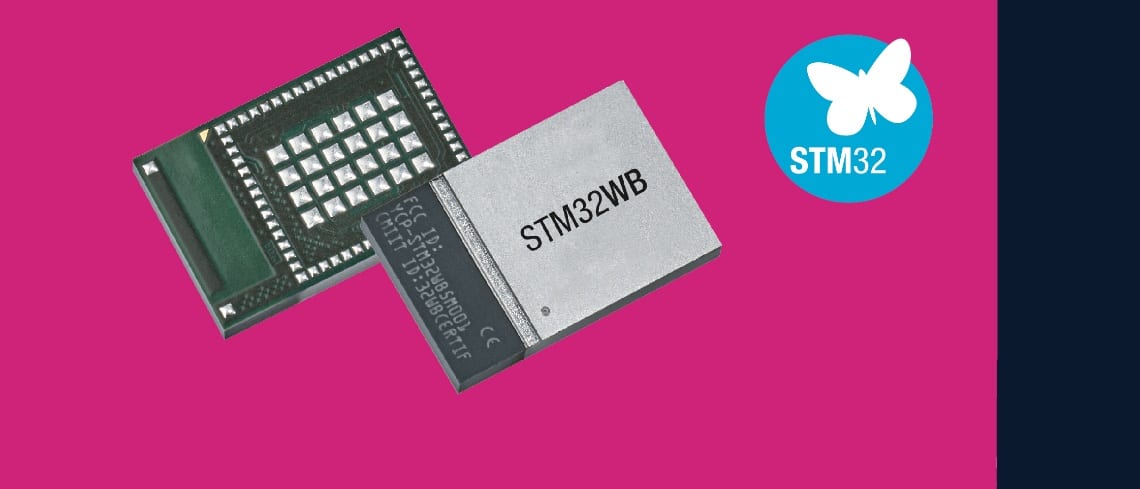
개요
STM32WB5MMG는 인증된 small-form-factor ultra-low-power 2.4GHz module입니다. BLE 5.4, Zigbee 3.0, OpenThread, dynamic/static concurrent mode와 proprietary 802.15.4를 지원합니다. 다른 보드, 특히 B-U585I-IOT02A에서 HCI layer로 쓰기 위해 이 board support가 추가되었습니다.
- SiP-LGA86 Bluetooth module
- integrated chip antenna
- BLE 5.4·Zigbee 3.0·OpenThread certification과 concurrent mode
- IEEE 802.15.4-2011 MAC/PHY, 2Mbit/s
- 2402~2480MHz
- advertising extension
- Tx 최대 +6dBm
- Rx -96dBm BLE 1Mbps·-100dBm 802.15.4
- range 최대 75m
- radio·security용 dedicated Cortex-M0+
- FPU·ART Cortex-M4 최대 64MHz
- Flash 1MB·SRAM 256KB
- 32MHz radio·32kHz RTC crystal 포함 BOM
- integrated SMPS
- battery용 ultra-low-power mode
- GPIO 68개
- SWD·JTAG
하드웨어
STM32WB55VGY 기반이며 revision Y는 MCU cut 2.1, revision X는 cut 2.2입니다. Radio는 Thread 1.3을 지원하며 ETSI EN 300 328·EN 300 440, FCC CFR47 Part 15, ARIB STD-T66 무선 규제 준수가 필요한 시스템에 적합합니다. Standby는 RTC와 RAM 32KB 유지 시 600nA까지 낮아집니다.
- FlexPowerControl ultra-low-power
- FPU Cortex-M4
- radio
- 2.4GHz
- Bluetooth 5.4
- IEEE 802.15.4-2011 PHY·MAC
- Zigbee 3.0
- BLE 1Mbps -96dBm·802.15.4 -100dBm sensitivity
- +6dBm까지 1dB step output
- integrated balun
- 2Mbps
- GATT caching
- EATT
- advertising extension
- power-control용 accurate RSSI
- clock
- integrated trimming capacitor 32MHz crystal
- RTC 32kHz LSE
- 32kHz ±5% LSI1
- 32kHz ±500ppm LSI2
- LSE auto-trimmed 100kHz~48MHz MSI, ±0.25%보다 우수
- factory-trimmed 16MHz HSI ±1%
- system·USB·SAI·ADC PLL 2개
- ADC·SPI·I2C·USART·QSPI·SAI·AES·timer용 7-channel DMA controller 2개
- USART 1개
- LPUART 1개
- 32Mbit/s SPI 2개
- SMBus/PMBus I2C 2개
- dual-channel SAI 1개
- crystal-less BCD·LPM USB 2.0 FS device
- touch sensor 최대 18개
- step-up LCD 8×40
- advanced 16-bit 4-channel timer 1개
- 16-bit 2-channel timer 2개
- 32-bit 4-channel timer 1개
- ultra-low-power 16-bit timer 2개
- independent SysTick·independent watchdog·window watchdog 각 1개
- fast I/O 최대 72개, 70개는 5V tolerant
- memory
- PCROP R/W sector protection Flash 최대 1MB
- hardware parity 64KB 포함 SRAM 최대 256KB
- 32-bit backup register 20개
- USART·SPI·I2C·USB bootloader
- BLE·802.15.4 OTA update
- XIP Quad-SPI
- OTP 1KB, 128 double-word
- sigma-delta digital filter 4개
- 1.62V까지 동작하는 analog peripheral
- hardware oversampling 최대 16-bit인 12-bit 4.26MSPS ADC
- ultra-low-power comparator 2개
- buffered 2.5V/2.048V reference
보안과 ID
- BLE·802.15.4 stack용 Secure Firmware Installation
- application·Bluetooth·IEEE 802.15.4용 최대 256-bit AES engine 3개
- customer key storage/manager
- hardware PKA
- RSA·Diffie-Hellman·ECC over GF(p)
- TRNG
- PCROP
- CRC
- 96-bit unique ID
- IEEE 64-bit unique ID에서 802.15.4 64-bit·BLE ID 파생 가능
- 48-bit EUI
Zephyr 지원 기능
| 인터페이스 | 컨트롤러 | 드라이버/컴포넌트 |
|---|---|---|
| UART | on-chip | serial port-polling; serial port-interrupt |
| RADIO | on-chip | Bluetooth Low Energy |
그 밖의 기능은 아직 지원되지 않습니다. 기본 설정은 boards/st/stm32wb5mmg/stm32wb5mmg_defconfig입니다.
Bluetooth coprocessor binary 호환성
Cortex-M0에 Cube package의 Projects/STM32WB_Copro_Wireless_Binaries/STM32WB5x/ binary가 필요합니다.
연결과 I/O
기본 Zephyr 주변장치 매핑
UART_1 TX/RX : PB7/PB6LPUART_1 TX/RX : PA3/PA2USB : PA11/PA12SWD : PA13/PA14
Clock·serial
기본 system clock은 32MHz HSE입니다. LPUART1은 HCI controller port로 main U585I MCU에 연결됩니다. USART1은 external pinout에 연결되지 않아 module을 직접 debug할 수 없습니다. 대신 CN12 USB VCP stack을 사용할 수 있습니다.
Module flash와 HCI 실습
B-U585I-IOT02A의 on-board ST-Link로 module을 flash합니다. 먼저 SW4 MCU SWD OFF, SW5 SWD BLE ON으로 두어 upload target을 STM32WB5MMG로 바꿉니다.
$ minicom -D /dev/ttyACM0west build -b stm32wb5mmg samples/bluetooth/hci_uart
west flash그다음 switch를 기본값인 SW4 ON, SW5 OFF로 되돌려 main MCU에 Bluetooth observer를 씁니다.
west build -b b_u585i_iot02a samples/bluetooth/observer
west flash
reset 뒤 예시 출력:
Starting Observer Demo
Started scanning...
Exiting main thread.
Device found: 2C:98:F3:64:58:06 (random) (RSSI -82), type 3, AD data len 31
Device found: CE:5B:9A:87:69:4F (random) (RSSI -80), type 3, AD data len 8
Device found: 7B:1E:DD:38:23:E1 (random) (RSSI -85), type 0, AD data len 17
debug
원문은 hci_uart debug 예시라고 설명하지만 실제 명령은 B-U585I-IOT02A의 observer sample입니다.
west build -b b_u585i_iot02a samples/bluetooth/observer
west debug
참고 자료
Source
출처
영어 원문에는 문단, 문서 지시문, 표, 코드, 코드 심벌, 경로를 그대로 보존했습니다.