Part 1
요약·해설
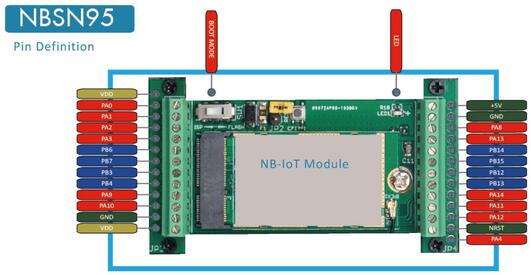
NBSN95은 STM32L072CZ Cortex-M0+, Quectel BC95-G NB-IoT modem, PMOD, screw-terminal GPIO와 Li/SOCl2 non-rechargeable battery를 방수 housing에 통합합니다.
STM32L072CZ · Cortex-M0+ · 32 MHz
Quectel BC95-G NB-IoT modem
UART · PINMUX · GPIO
Part 2
접을 수 있는 영어 원문 전체
영어 원문 전체 펼치기
BECF64A7970FDAD1A19E6896CD1E185AD9DA9A6C4841EB5763DEEE8F03CAC7D3
.. _dragino_nbsn95_board:

Dragino NBSN95 NB-IoT Sensor Node
#################################

Overview
********

The Dragino NBSN95 NB-IoT Sensor Node for IoT allows users to develop
applications with NB-IoT connectivity via the Quectel BC95-G.
Dragino NBSN95 enables a wide diversity of applications by exploiting
low-power communication, ARM |reg| Cortex |reg|-M0 core-based
STM32L0 Series features.

This kit provides:

- STM32L072CZ MCU
- Quectel BC95-G NB-IoT
- Expansion connectors:
        - PMOD
- Li/SOCI2 Unchargable Battery
- GPIOs exposed via screw terminals on the carrier board
- Housing

.. image:: ../../../../../../../boards/dragino/nbsn95/doc/img/dragino_nbsn95.jpg
     :align: center
     :alt: Dragino NBSN95

More information about the board can be found at the `Dragino NBSN95 website`_.

Hardware
********

The STM32L072CZ SoC provides the following hardware IPs:

- Ultra-low-power (down to 0.29 µA Standby mode and 93 uA/MHz run mode)
- Core: ARM |reg| 32-bit Cortex |reg|-M0+ CPU, frequency up to 32 MHz
- Clock Sources:

        - 1 to 32 MHz crystal oscillator
        - 32 kHz crystal oscillator for RTC (LSE)
        - Internal 16 MHz factory-trimmed RC ( |plusminus| 1%)
        - Internal low-power 37 kHz RC ( |plusminus| 5%)
        - Internal multispeed low-power 65 kHz to 4.2 MHz RC
- RTC with HW calendar, alarms and calibration
- Up to 24 capacitive sensing channels: support touchkey, linear and rotary touch sensors
- 11x timers:

        - 2x 16-bit with up to 4 channels
        - 2x 16-bit with up to 2 channels
        - 1x 16-bit ultra-low-power timer
        - 1x SysTick
        - 1x RTC
        - 2x 16-bit basic for DAC
        - 2x watchdogs (independent/window)
- Up to 84 fast I/Os, most 5 V-tolerant.
- Memories

        - Up to 192 KB Flash, 2 banks read-while-write, proprietary code readout protection
        - Up to 20 KB of SRAM
        - External memory interface for static memories supporting SRAM, PSRAM, NOR and NAND memories
- Rich analog peripherals (independent supply)

        - 1x 12-bit ADC 1.14 MSPS
        - 2x 12-bit DAC
        - 2x ultra-low-power comparators
- 11x communication interfaces

        - USB OTG 2.0 full-speed, LPM and BCD
        - 3x I2C FM+(1 Mbit/s), SMBus/PMBus
        - 4x USARTs (ISO 7816, LIN, IrDA, modem)
        - 6x SPIs (4x SPIs with the Quad SPI)
- 7-channel DMA controller
- True random number generator
- CRC calculation unit, 96-bit unique ID
- Development support: serial wire debug (SWD), JTAG, Embedded Trace Macrocell |trade|


More information about STM32L072CZ can be found here:

        - `STM32L072CZ on www.st.com`_
        - `STM32L0x2 reference manual`_

Supported Features
==================

The Zephyr Dragino NBSN95 board configuration supports the following hardware features:

+-----------+------------+-------------------------------------+
| Interface | Controller | Driver/Component                    |
+===========+============+=====================================+
| UART      | on-chip    | serial port-polling;                |
|           |            | serial port-interrupt               |
+-----------+------------+-------------------------------------+
| PINMUX    | on-chip    | pinmux                              |
+-----------+------------+-------------------------------------+
| GPIO      | on-chip    | gpio                                |
+-----------+------------+-------------------------------------+

Other hardware features are not yet supported on this Zephyr port.

The default configuration can be found in the defconfig file:
:zephyr_file:`boards/dragino/nbsn95/dragino_nbsn95_defconfig`


Connections and IOs
===================

Dragino NBSN95 Board has GPIO controllers. These controllers are responsible for pin muxing,
input/output, pull-up, etc.

Available pins:
---------------

For detailed information about available pins please refer to `Dragino NBSN95 website`_.

Default Zephyr Peripheral Mapping:
----------------------------------

- UART_1_TX : PB6
- UART_1_RX : PB7
- UART_2_TX : PA2
- UART_2_RX : PA3

System Clock
------------

Dragino NBSN95 System Clock is at 32MHz,

Serial Port
-----------

Dragino NBSN95 board has 2 U(S)ARTs. The Zephyr console output is assigned to UART1.
Default settings are 115200 8N1.

Programming and Debugging
*************************

Applications for the ``dragino_nbsn95`` board configuration can be built and
flashed in the usual way (see :ref:`build_an_application` and
:ref:`application_run` for more details).

Flashing
========

Dragino NBSN95  board requires an external debugger.

Flashing an application to Dragino NBSN95
-----------------------------------------

Here is an example for the :ref:`hello_world` application.

Connect the Dragino NBSN95 to a STLinkV2 to your host computer using the USB port, then
run a serial host program to connect with your board. For example:

.. code-block:: console

   $ minicom -D /dev/ttyACM0

Then build and flash the application:

.. zephyr-app-commands::
   :zephyr-app: samples/hello_world
   :board: dragino_nbsn95
   :goals: build flash

You should see the following message on the console:

.. code-block:: console

   $ Hello World! dragino_nbsn95

Debugging
=========

You can debug an application in the usual way.  Here is an example for the
:ref:`hello_world` application.

.. zephyr-app-commands::
   :zephyr-app: samples/hello_world
   :board: dragino_nbsn95
   :maybe-skip-config:
   :goals: debug

.. _Dragino NBSN95 website:
   https://www.dragino.com/products/nb-iot/item/163-nbsn95.html

.. _STM32L072CZ on www.st.com:
   https://www.st.com/en/microcontrollers/stm32l072cz.html

.. _STM32L0x2 reference manual:
   https://www.st.com/resource/en/reference_manual/DM00108281.pdf
Part 3
한국어 전문 번역
개요
IoT용 Dragino NBSN95 NB-IoT Sensor Node는 Quectel BC95-G NB-IoT modem를 통해 NB-IoT 연결을 사용하는 application을 개발할 수 있게 합니다. STM32L0 series의 Arm Cortex-M0 core 기반 기능과 low-power communication을 활용해 다양한 application을 구현할 수 있습니다.
kit는 다음을 제공합니다.
- STM32L072CZ MCU
- Quectel BC95-G NB-IoT modem
- PMOD expansion connector
- Li/SOCl2 non-rechargeable battery
- carrier board screw terminal로 노출되는 GPIO
- housing
보드에 대한 자세한 내용은 Dragino NBSN95 website에서 확인할 수 있습니다.
하드웨어
STM32L072CZ SoC는 다음 hardware IP를 제공합니다.
- ultra-low-power: Standby mode 최저 0.29 µA, run mode 93 µA/MHz
- 최대 32 MHz Arm 32-bit Cortex-M0+ CPU
- clock source
- 1~32 MHz crystal oscillator
- RTC용 32 kHz crystal oscillator(LSE)
- factory-trimmed internal 16 MHz RC(±1%)
- internal low-power 37 kHz RC(±5%)
- internal multispeed low-power 65 kHz~4.2 MHz RC
- hardware calendar, alarm, calibration을 지원하는 RTC
- 최대 24개 capacitive sensing channel: touchkey, linear·rotary touch sensor 지원
- timer 11개
- 최대 4 channel의 16-bit timer 2개
- 최대 2 channel의 16-bit timer 2개
- 16-bit ultra-low-power timer 1개
- SysTick 1개
- RTC 1개
- DAC용 16-bit basic timer 2개
- watchdog 2개(independent/window)
- fast I/O 최대 84개, 대부분 5 V tolerant
- memory
- flash 최대 192 KB, read-while-write bank 2개, proprietary code readout protection
- SRAM 최대 20 KB
- SRAM·PSRAM·NOR·NAND static memory를 지원하는 external memory interface
- independent supply를 사용하는 풍부한 analog peripheral
- 12-bit ADC 1개, 1.14 MSPS
- 12-bit DAC 2개
- ultra-low-power comparator 2개
- communication interface 11개
- USB OTG 2.0 full-speed, LPM·BCD
- I2C FM+ 3개(1 Mbit/s), SMBus/PMBus
- USART 4개(ISO 7816, LIN, IrDA, modem)
- SPI 6개(Quad SPI를 포함한 SPI 4개)
- 7-channel DMA controller
- true random number generator
- CRC calculation unit와 96-bit unique ID
- serial wire debug(SWD), JTAG, Embedded Trace Macrocell 개발 지원
STM32L072CZ의 자세한 내용은 ST product page와 STM32L0x2 reference manual을 참고하십시오.
지원 기능
Zephyr Dragino NBSN95 board configuration은 다음 hardware 기능을 지원합니다.
| Interface | Controller | Driver/Component |
|---|---|---|
| UART | on-chip | serial port-polling; serial port-interrupt |
| PINMUX | on-chip | pinmux |
| GPIO | on-chip | gpio |
다른 hardware 기능은 아직 이 Zephyr port에서 지원하지 않습니다. 기본 configuration은 boards/dragino/nbsn95/dragino_nbsn95_defconfig에서 확인할 수 있습니다.
연결과 I/O
Dragino NBSN95 board에는 pin muxing, input/output, pull-up 등을 담당하는 GPIO controller가 있습니다. 사용할 수 있는 pin의 자세한 정보는 Dragino NBSN95 website를 참고하십시오.
기본 Zephyr peripheral mapping
- UART_1_TX: PB6
- UART_1_RX: PB7
- UART_2_TX: PA2
- UART_2_RX: PA3
System clock
Dragino NBSN95 system clock은 32 MHz입니다.
Serial port
Dragino NBSN95 board에는 U(S)ART가 2개 있습니다. Zephyr console output은 UART1에 할당되며 기본 설정은 115200 8N1입니다.
프로그래밍과 디버깅
dragino_nbsn95 board configuration용 application은 일반적인 방법으로 build하고 flash할 수 있습니다.
Flashing
Dragino NBSN95 board에는 external debugger가 필요합니다.
Dragino NBSN95에 application flash
다음은 hello_world 예입니다. Dragino NBSN95을 ST-Link V2에 연결하고 USB port로 host computer에 연결한 뒤 serial host program으로 board에 접속합니다.
$ minicom -D /dev/ttyACM0그 다음 application을 build하고 flash합니다.
west build -b dragino_nbsn95 samples/hello_world
west flash
console에 다음 message가 보여야 합니다.
$ Hello World! dragino_nbsn95Debugging
일반적인 방법으로 application을 debug할 수 있습니다. 다음은 hello_world 예입니다.
west build -b dragino_nbsn95 samples/hello_world
west debug
참고 자료
Source
출처
영어 원문에는 문단, 문서 지시문, 표, 코드, 코드 심벌, 경로를 그대로 보존했습니다.