Part 1
요약·해설
Classical CAN 8 byte와 CAN FD 64 byte 한계를 넘어 payload를 segment하고 SF·FF·CF·FC, block size와 STmin으로 전송을 제어합니다.
ISO 15765-2
SF · FF · CF · FC
BS · STmin
Part 2
접을 수 있는 영어 원문 전체
영어 원문 전체 펼치기
E3744AF22EE13E185E02C0472B676F51D05DA7D3FD83BB96B7FDD99F4B137840
.. _can_isotp:

ISO-TP Transport Protocol
#########################

.. contents::
    :local:
    :depth: 2

Overview
********

ISO-TP is a transport protocol defined in the ISO-Standard ISO15765-2 Road
vehicles - Diagnostic communication over Controller Area Network (DoCAN).
Part2: Transport protocol and network layer services. As its name already
implies, it is originally designed, and still used in road vehicle diagnostic
over Controller Area Networks. Nevertheless, it's not limited to applications in
road vehicles or the automotive domain.

This transport protocol extends the limited payload data size for classical
CAN (8 bytes) and CAN FD (64 bytes) to theoretically four gigabytes.
Additionally, it adds a flow control mechanism to influence the sender's
behavior. ISO-TP segments packets into small fragments depending on the payload
size of the CAN frame. The header of those segments is called Protocol Control
Information (PCI).

Packets smaller or equal to seven bytes on Classical CAN are called
single-frames (SF). They don't need to fragment and do not have any flow-control.

Packets larger than that are segmented into a first-frame (FF) and as many
consecutive-frames (CF) as required. The FF contains information about the length of
the entire payload data and additionally, the first few bytes of payload data.
The receiving peer sends back a flow-control-frame (FC) to either deny,
postpone, or accept the following consecutive frames.
The FC also defines the conditions of sending, namely the block-size (BS) and
the minimum separation time between frames (STmin). The block size defines how
many CF the sender is allowed to send, before he has to wait for another FC.

.. image:: ../../../../connectivity/canbus/isotp_sequence.svg
   :width: 20%
   :align: center
   :alt: ISO-TP Sequence

API Reference
*************

.. doxygengroup:: can_isotp
Part 3
한국어 전문 번역
ISO-TP Transport Protocol
Overview
ISO-TP는 ISO 15765-2, Road vehicles - Diagnostic communication over Controller Area Network(DoCAN), Part 2: Transport protocol and network layer services에 정의된 transport protocol입니다. 이름처럼 원래 road vehicle의 CAN 진단을 위해 설계됐고 지금도 그 용도로 사용하지만, road vehicle이나 automotive domain에만 제한되지는 않습니다.
이 transport protocol은 Classical CAN의 8 byte와 CAN FD의 64 byte로 제한된 payload를 이론상 4 gigabyte까지 확장합니다. 또한 sender 동작에 영향을 주는 flow-control mechanism을 추가합니다. ISO-TP는 CAN frame payload 크기에 따라 packet을 작은 fragment로 나누며, 각 segment의 header를 Protocol Control Information(PCI)이라고 합니다.
Classical CAN에서 7 byte 이하인 packet은 single-frame(SF)이라고 합니다. Fragmentation이 필요하지 않고 flow control도 없습니다.
그보다 큰 packet은 first-frame(FF) 하나와 필요한 수의 consecutive-frame(CF)으로 나눕니다. FF에는 전체 payload data 길이와 payload 앞부분이 들어갑니다. Receiving peer는 flow-control-frame(FC)을 돌려보내 이어지는 CF를 거부하거나, 미루거나, 허용합니다.
FC는 전송 조건인 block size(BS)와 frame 사이 최소 separation time(STmin)도 정합니다. Block size는 sender가 다음 FC를 기다리기 전에 보낼 수 있는 CF 개수입니다.
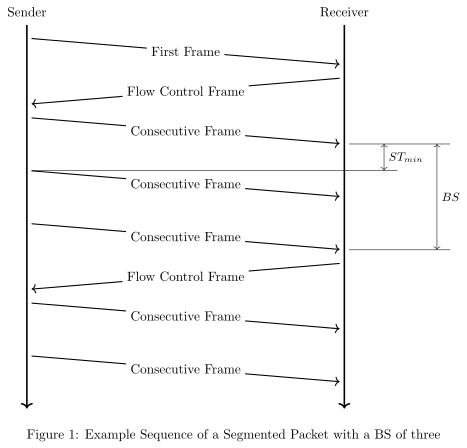
API Reference
Zephyr API reference는 Doxygen group can_isotp에서 제공합니다.
Source
출처
영어 원문에는 문단, 문서 지시문, 표, 코드, 코드 심벌, 경로를 그대로 보존했습니다.