Part 1
요약·해설
Swan은 STM32L4R5ZI, flash 2 MB, RAM 640 KB를 사용합니다. memory를 보존하는 low-power mode에서 board 전체가 약 8 μA를 소비하며 external sensor용 2 A regulator를 software로 켤 수 있습니다.
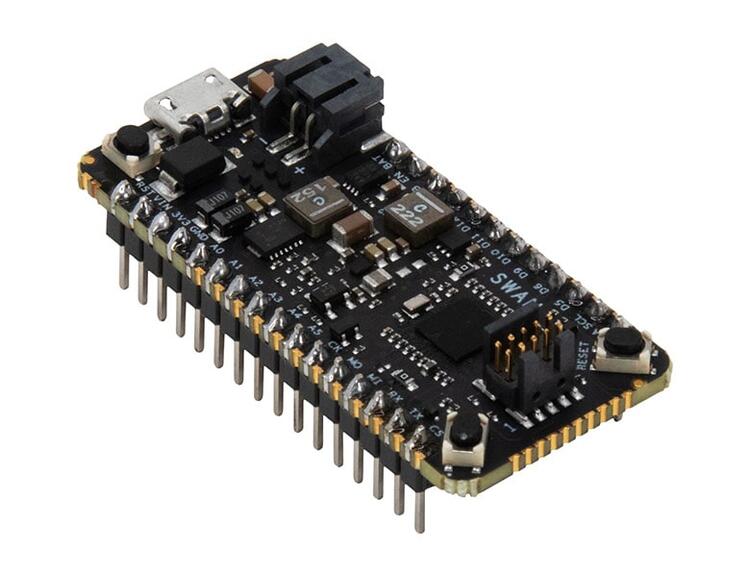
STM32L4R5ZI Cortex-M4 · up to 120 MHz
2 MB flash · 640 KB SRAM
USB · battery · line; about 8 μA low-power
Part 2
접을 수 있는 영어 원문 전체
영어 원문 전체 펼치기
101C167847CF8B72C805843868D7F5252CB058450A5F18C223CD0881DF1BAC9C
.. _swan_r5_board:

Blues Wireless Swan
###################

Overview
********

Swan is a low-cost embeddable STM32L4-based microcontroller designed to
accelerate the development and deployment of battery-powered solutions.
It is especially useful for applications requiring large memory or a high
degree of I/O expandability at an affordable cost, such as edge inferencing
and remote monitoring.

Uniquely for Feather-compatible boards, Swan is designed to satisfy
developers' needs that span from early prototyping through high-volume
deployment. Developers may begin to use Swan in conjunction with
Adafruit's myriad sensors and FeatherWing-compatible carriers.
Due to its novel design, for high-volume deployment the low-cost Swan
can also be soldered directly to a parent PCB integrating those sensors,
utilizing the full range of Swan's I/O capabilities.

The board has three independent power options-USB, Battery, or Line power-
and provides a software-switchable 2 Amp regulator for powering external
sensors. When operating in its low-power operating mode, the entire Swan
board commonly draws only about 8uA while retaining all of its memory,
making it quite suitable for battery-powered devices.

The Swan board features an ARM Cortex-M4 based STM32L4R5ZI MCU
with a wide range of connectivity support and configurations. Here are
some highlights of the board:

- STM32 microcontroller in WLCSP144 package
- 2MB of flash and 640KB of RAM
- Two types of extension resources:

  - Adafruit Feather-compatible connectivity
  - Access to 36 additional STM32 pins (beyond the Feather pins) via 0.05" castellated edge headers

- On-board ST-LINKV3 debugger/programmer with SWD connector

- One Red User LED (LD1)
- Two push-buttons: USER and RESET

- Castellated-edge access to 55 GPIO ports including:

  - 8 analog
  - 16 digital
  - 4x I2C, 3x SPI
  - USB OTG full speed
  - 1x 14-channel DMA
  - tRNG
  - 12-bit ADC, 2 x 12-bit DAC
  - low-power RTC, and CRC calculation peripherals

.. image:: ../../../../../../../boards/blues/swan_r5/doc/img/swan.jpg
     :align: center
     :alt: Blues Wireless Swan

More information about the board can be found at the `Swan Product Page`_.

Hardware
********

The STM32L4R5ZI SoC provides the following hardware IPs:

- Ultra-low-power with FlexPowerControl (down to 130 nA Standby mode
  and 100 uA/MHz run mode)
- Core: ARM |reg| 32-bit Cortex |reg|-M4 CPU with FPU, adaptive
  real-time accelerator (ART Accelerator) allowing 0-wait-state
  execution from Flash memory, frequency up to 120 MHz, MPU, 150
  DMIPS/1.25 DMIPS/MHz (Dhrystone 2.1), and DSP instructions

- Memories

  - 2-Mbyte Flash, 2 banks read-while-write, proprietary code readout protection
  - 640 Kbytes of SRAM including 64 Kbytes with hardware parity check
  - External memory interface for static memories supporting SRAM,
    PSRAM, NOR, NAND and FRAM memories
  - 2 x OctoSPI memory interface

- True random number generator
- CRC calculation unit, 96-bit unique ID
- Development support: serial wire debug (SWD), JTAG, Embedded Trace
  Macrocell (ETM)

More information about Swan can be found here:

- `Swan Quickstart Guide`_
- `Swan Datasheet`_

Supported Features
==================

The Zephyr Swan board configuration supports the following
hardware features:

+-----------+------------+-------------------------------------+
| Interface | Controller | Driver/Component                    |
+===========+============+=====================================+
| NVIC      | on-chip    | nested vector interrupt controller  |
+-----------+------------+-------------------------------------+
| UART      | on-chip    | serial port-polling;                |
|           |            | serial port-interrupt               |
+-----------+------------+-------------------------------------+
| PINMUX    | on-chip    | pinmux                              |
+-----------+------------+-------------------------------------+
| GPIO      | on-chip    | gpio                                |
+-----------+------------+-------------------------------------+
| I2C       | on-chip    | i2c                                 |
+-----------+------------+-------------------------------------+
| PWM       | on-chip    | pwm                                 |
+-----------+------------+-------------------------------------+
| SPI       | on-chip    | spi                                 |
+-----------+------------+-------------------------------------+
| USB       | on-chip    | usb                                 |
+-----------+------------+-------------------------------------+
| ADC       | on-chip    | adc                                 |
+-----------+------------+-------------------------------------+

Other hardware features are not yet supported on this Zephyr port.

The default configuration can be found in the defconfig file:
:zephyr_file:`boards/blues/swan_r5/swan_r5_defconfig`


Connections and IOs
===================

Default Zephyr Peripheral Mapping:
----------------------------------

.. rst-class:: rst-columns

- A0 : PA3
- A1 : PA1
- A2 : PC3
- A3 : PC1
- A4 : PC4
- A5 : PC5
- D4 : PE3
- D5 : PE11
- D6 : PE9
- D9 : PD15
- D10 : PA4
- D11 : PA7
- D12 : PA6
- D13 : PA5
- UART_1_TX : PA9
- UART_1_RX : PA10
- UART_2_TX : PA2
- UART_2_RX : PD6
- UART_3_TX : PB10
- UART_3_RX : PB11
- LPUART_TX : PG7
- LPUART_RX : PG8
- I2C_1_SCL : PB6
- I2C_1_SDA : PB7
- I2C_2_SCL : PF1
- I2C_2_SDA : PF0
- I2C_3_SCL : PC0
- I2C_3_SDA : PC9
- SPI_1_NSS : PA4
- SPI_1_SCK : PA5
- SPI_1_MISO : PA6
- SPI_1_MOSI : PA7
- SPI_2_NSS : PD0
- SPI_2_SCK : PD1
- SPI_2_MISO : PB14
- SPI_2_MOSI : PB15
- SPI_3_NSS : PA15
- SPI_3_SCK : PC10
- SPI_3_MISO : PC11
- SPI_3_MOSI : PC12
- PWM_2_CH1 : PA0
- USER_PB : PC13
- LD1 : PE2
- USB DM : PA11
- USB DP : PA12
- ADC1 : PA1

System Clock
------------

Swan System Clock could be driven by internal or external
oscillator, as well as main PLL clock. By default, the System clock is
driven by the PLL clock at 80MHz, driven by a 16MHz high speed
internal oscillator.

Serial Port
-----------

Swan has 4 U(S)ARTs. The Zephyr console output is
assigned to LPUART.  Default settings are 115200 8N1.

Programming and Debugging
*************************

Connect Swan to your host computer using the USB port.
Then build and flash an application. Here is an example for the
:ref:`hello_world` application.

Run a serial host program to connect with your Swan:

.. code-block:: console

   $ minicom -D /dev/ttyACM0

Then build and flash the application.

.. zephyr-app-commands::
   :zephyr-app: samples/hello_world
   :board: swan_r5
   :goals: build flash

You should see the following message on the console:

.. code-block:: console

   Hello World! arm

References
**********

.. _Swan Product Page:
   https://blues.io/products/swan

.. _Swan Quickstart Guide:
   https://dev.blues.io/start/swan/swan-quickstart

.. _Swan Datasheet:
   https://dev.blues.io/hardware/swan-datasheet/
Part 3
한국어 전문 번역
개요
Swan은 battery-powered solution의 개발과 deployment를 빠르게 하는 저가형 embedded STM32L4 microcontroller board입니다. 큰 memory나 많은 I/O가 필요한 edge inferencing, remote monitoring에 적합합니다.
Feather-compatible sensor와 carrier로 prototype을 만들 수 있고, 양산 단계에서는 Swan을 parent PCB에 직접 solder해 전체 I/O를 사용할 수 있습니다. USB·battery·line 세 가지 independent power option과 external sensor용 software-switchable 2 A regulator를 제공합니다. low-power mode에서는 memory를 모두 보존하면서 board 전체가 보통 약 8 μA만 소비합니다.
WLCSP144 STM32L4R5ZI, flash 2 MB, RAM 640 KB, Feather interface와 0.05-inch castellated edge의 추가 STM32 pin 36개, ST-LINKV3/SWD, red LED, USER·RESET button을 갖춥니다. castellated edge로 GPIO 55개를 노출하며 analog 8개, digital 16개, I2C 4개, SPI 3개, USB OTG FS, 14-channel DMA, TRNG, 12-bit ADC, 12-bit DAC 2개, low-power RTC, CRC를 사용할 수 있습니다.
하드웨어
STM32L4R5ZI는 FlexPowerControl로 Standby 130 nA, run mode 100 μA/MHz까지 낮춥니다. FPU·DSP·MPU를 포함한 32-bit Cortex-M4, ART Accelerator의 zero-wait-state flash 실행, 최대 120 MHz, 150 DMIPS/1.25 DMIPS/MHz를 제공합니다.
- read-while-write 2-bank flash 2 MB와 proprietary code readout protection
- hardware parity 64 KB를 포함한 SRAM 640 KB
- SRAM·PSRAM·NOR·NAND·FRAM용 external static memory interface
- OctoSPI interface 2개
- TRNG, CRC, 96-bit unique ID
- SWD, JTAG, Embedded Trace Macrocell
지원 기능
| Interface | Controller | Driver/Component |
|---|---|---|
| NVIC | on-chip | nested vector interrupt controller |
| UART | on-chip | serial port-polling; serial port-interrupt |
| PINMUX | on-chip | pinmux |
| GPIO | on-chip | gpio |
| I2C | on-chip | i2c |
| PWM | on-chip | pwm |
| SPI | on-chip | spi |
| USB | on-chip | usb |
| ADC | on-chip | adc |
다른 hardware는 아직 이 port에서 지원하지 않습니다. 기본 구성은 boards/blues/swan_r5/swan_r5_defconfig입니다.
연결과 I/O
| Peripheral | Pin |
|---|---|
| A0 | PA3 |
| A1 | PA1 |
| A2 | PC3 |
| A3 | PC1 |
| A4 | PC4 |
| A5 | PC5 |
| D4 | PE3 |
| D5 | PE11 |
| D6 | PE9 |
| D9 | PD15 |
| D10 | PA4 |
| D11 | PA7 |
| D12 | PA6 |
| D13 | PA5 |
| UART_1_TX | PA9 |
| UART_1_RX | PA10 |
| UART_2_TX | PA2 |
| UART_2_RX | PD6 |
| UART_3_TX | PB10 |
| UART_3_RX | PB11 |
| LPUART_TX | PG7 |
| LPUART_RX | PG8 |
| I2C_1_SCL | PB6 |
| I2C_1_SDA | PB7 |
| I2C_2_SCL | PF1 |
| I2C_2_SDA | PF0 |
| I2C_3_SCL | PC0 |
| I2C_3_SDA | PC9 |
| SPI_1_NSS | PA4 |
| SPI_1_SCK | PA5 |
| SPI_1_MISO | PA6 |
| SPI_1_MOSI | PA7 |
| SPI_2_NSS | PD0 |
| SPI_2_SCK | PD1 |
| SPI_2_MISO | PB14 |
| SPI_2_MOSI | PB15 |
| SPI_3_NSS | PA15 |
| SPI_3_SCK | PC10 |
| SPI_3_MISO | PC11 |
| SPI_3_MOSI | PC12 |
| PWM_2_CH1 | PA0 |
| USER_PB | PC13 |
| LD1 | PE2 |
| USB DM | PA11 |
| USB DP | PA12 |
| ADC1 | PA1 |
System clock
internal 또는 external oscillator와 main PLL을 사용할 수 있습니다. 기본 system clock은 16 MHz high-speed internal oscillator가 구동하는 PLL의 80 MHz입니다.
Serial port
U(S)ART는 4개이며 Zephyr console은 LPUART에 배정됩니다. 기본 설정은 115200 8N1입니다.
프로그래밍과 디버깅
USB로 host에 연결하고 serial terminal을 연 뒤 application을 build·flash합니다.
minicom -D /dev/ttyACM0
west build -b swan_r5 samples/hello_world
west flash
console에 Hello World! arm이 나타납니다.
참고 자료
Source
출처
영어 원문에는 문단, 문서 지시문, 표, 코드, 코드 심벌, 경로를 그대로 보존했습니다.