Part 1
요약·해설
SAM4L은 active current를 90 μA/MHz까지 낮춥니다. WAIT와 RETENTION은 logic·RAM을 보존하고, BACKUP은 CPU·peripheral·RAM 전원을 끕니다.
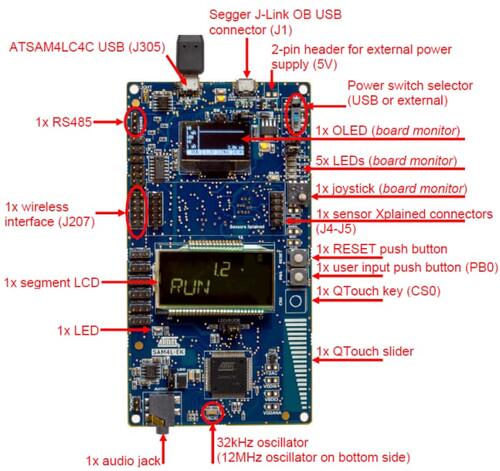
ATSAM4LC4C Cortex-M4
12 MHz → PLL → 48 MHz
Segger J-Link OB
Part 2
접을 수 있는 영어 원문 전체
영어 원문 전체 펼치기
783A0D314C967458A6B2E95D8871FA00C8B7F1EFB0185294384B6C8CFC02C381
.. _sam4l_ek:

SAM4L-EK
########

Overview
********

The SAM4L series embeds picoPower technology for ultra-low power consumption.
Combined power control techniques are used to bring active current consumption
down to 90μA/MHz.  The device allows a wide range of configurations giving the
user the ability to balance between the lowest possible power consumption and
the feature set selected for the application.  The WAIT and RETENTION modes
provide full logic and RAM retention, associated with fast wake-up capability
(<1.5μs) and a very low consumption of, respectively, 3 μA and 1.5 μA.  In
addition, WAIT mode supports SleepWalking features.  In BACKUP mode, CPU,
peripherals and RAM are powered off consuming less than 0.9μA with external
interrupt wake-up support.

The SAM4L-EK is a full featured design to develop for Atmel SAM4L SoC series.
The kit is equipped with a rich set of peripherals that make the ATSAM4L-EK a
perfect evaluation platform.  Download the `SAM4L-EK Online User Guide`_ for
more details.

.. image:: ../../../../../../../../boards/atmel/sam/sam4l_ek/doc/img/atmel-sam4l-ek-callouts.jpg
     :align: center
     :alt: SAM4L-EK

Hardware
********

- ATSAM4LC4C ARM Cortex-M4 Processor
- 12 MHz crystal oscillator
- 32.768 kHz crystal oscillator
- 1 Micro-AB USB OTG host/device
- 1 AT86RF2xx IEEE 802.15.4 transceiver connector
- 1 RS-485 full duplex interface
- 1 Sensor Xplained board connector
- 1 Audio Jack connector 3.5mm
- 1 Dedicated Board Monitor MCU

  - Power measurement (VDDIN, VDDIO, VDDANA)
  - 1 OLED Display (128x64)
  - 5 LEDs
  - 1 Joystick
  - 1 USART
  - 1 TWI
- 1 40x4 LCD Segment Display
- 1 user touch button and One user pushbutton
- 1 user LED
- 1 QTouch Slider
- 1 QTouch Button
- 1 TEMT6000 Light Sensor
- 1 AT25DF641A Serial NOR Flash

Supported Features
==================

The sam4l_ek board configuration supports the following hardware features:

+-----------+------------+-------------------------------------+
| Interface | Controller | Driver/Component                    |
+===========+============+=====================================+
| MPU       | on-chip    | arch/arm                            |
+-----------+------------+-------------------------------------+
| NVIC      | on-chip    | arch/arm                            |
+-----------+------------+-------------------------------------+
| SYSTICK   | on-chip    | systick                             |
+-----------+------------+-------------------------------------+
| COUNTER   | on-chip    | counter                             |
+-----------+------------+-------------------------------------+
| GPIO      | on-chip    | gpio                                |
+-----------+------------+-------------------------------------+
| HWINFO    | on-chip    | Unique 120 bit serial number        |
+-----------+------------+-------------------------------------+
| SPI       | on-chip    | spi                                 |
+-----------+------------+-------------------------------------+
| TRNG      | on-chip    | entropy                             |
+-----------+------------+-------------------------------------+
| TWIM      | on-chip    | i2c master port-interrupt           |
+-----------+------------+-------------------------------------+
| USART     | on-chip    | serial port                         |
+-----------+------------+-------------------------------------+
| USB       | on-chip    | usb device                          |
+-----------+------------+-------------------------------------+

Other hardware features are not currently supported by Zephyr.

The default configuration can be found in the Kconfig
:zephyr_file:`boards/atmel/sam/sam4l_ek/sam4l_ek_defconfig`.

Connections and IOs
===================

The `SAM4L-EK Design Documentation`_ has detailed information about board
connections.  Download the `SAM4L-EK Design Documentation`_ for more details.

System Clock
============

The SAM4L MCU is configured to use the 12 MHz internal oscillator on the board
with the on-chip PLL to generate an 48 MHz system clock.

Serial Port
===========

The ATSAM4LC4C MCU has 4 USARTs.  One of the USARTs (USART2) is connected on
the embedded debug unit and can works as a console.  The USART0 is shared
between all others headers and RS-485 port.

Programming and Debugging
*************************

The SAM4L-EK board have a Segger Embedded Debugger Unit
`J-Link OB <https://www.segger.com/jlink-ob.html>`_.  This provides a debug
interface to the SAM4LC4C chip. You can use Ozone or JLink to communicate with
the SAM4LC4C.

Flashing
========

#. Download JLink from the Segger `JLink Downloads Page`_.  Go to the section
   "J-Link Software and Documentation Pack" and install the "J-Link Software
   and Documentation pack for Linux".  The application JLinkExe needs to be
   accessible from your path.

#. Run your favorite terminal program to listen for output.  Under Linux the
   terminal should be :code:`/dev/ttyACM0`. For example:

   .. code-block:: console

      $ minicom -D /dev/ttyACM0 -o

   The -o option tells minicom not to send the modem initialization string.
   Connection should be configured as follows:

   - Speed: 115200
   - Data: 8 bits
   - Parity: None
   - Stop bits: 1

#. Connect the SAM4L-EK board to your host computer using the USB debug port.
   Then build and flash the :ref:`hello_world` application.

   .. zephyr-app-commands::
      :zephyr-app: samples/hello_world
      :board: sam4l_ek
      :goals: build flash

   You should see "Hello World! sam4l_ek" in your terminal.

Debugging
=========

You can debug an application in the usual way.  Here is an example for the
:ref:`hello_world` application.

.. zephyr-app-commands::
   :zephyr-app: samples/hello_world
   :board: sam4l_ek
   :maybe-skip-config:
   :goals: debug

References
**********

.. target-notes::

.. _SAM4L-EK Online User Guide:
    http://ww1.microchip.com/downloads/en/DeviceDoc/Atmel-42026-ATSAM4L-EK-User-Guide_ApplicationNote_AVR32850.pdf

.. _SAM4L-EK Design Documentation:
    http://ww1.microchip.com/downloads/en/DeviceDoc/doc42027_SAM4L-EK_Design_Documentation.PDF

.. _JLink Downloads Page:
    https://www.segger.com/downloads/jlink
Part 3
한국어 전문 번역
개요
SAM4L series는 ultra-low power용 picoPower technology를 내장합니다. 여러 power control 기술로 active current를 90 μA/MHz까지 낮추며, application의 기능과 최저 소비 전력 사이를 조정할 수 있습니다. WAIT와 RETENTION mode는 logic과 RAM을 모두 보존하면서 1.5 μs 미만의 빠른 wake-up을 제공하고 각각 3 μA와 1.5 μA를 소비합니다. WAIT mode는 SleepWalking도 지원합니다. BACKUP mode는 CPU, peripheral, RAM 전원을 끄고 external interrupt wake-up을 지원하면서 0.9 μA 미만을 소비합니다.
SAM4L-EK는 SAM4L SoC 개발용 full-featured evaluation platform입니다.
하드웨어
- ATSAM4LC4C Arm Cortex-M4, 12 MHz와 32.768 kHz crystal
- Micro-AB USB OTG host/device
- AT86RF2xx IEEE 802.15.4 transceiver connector, RS-485 full-duplex, Sensor Xplained connector
- 3.5 mm audio jack, dedicated Board Monitor MCU
- monitor 기능: VDDIN·VDDIO·VDDANA power measurement, 128×64 OLED, LED 5개, joystick, USART, TWI
- 40×4 LCD segment display
- user touch button·pushbutton·LED, QTouch slider·button
- TEMT6000 light sensor, AT25DF641A Serial NOR Flash
지원 기능
| Interface | Controller | Driver/Component |
|---|---|---|
| MPU | on-chip | arch/arm |
| NVIC | on-chip | arch/arm |
| SYSTICK | on-chip | systick |
| COUNTER | on-chip | counter |
| GPIO | on-chip | gpio |
| HWINFO | on-chip | Unique 120 bit serial number |
| SPI | on-chip | spi |
| TRNG | on-chip | entropy |
| TWIM | on-chip | i2c master port-interrupt |
| USART | on-chip | serial port |
| USB | on-chip | usb device |
다른 hardware는 현재 지원하지 않습니다. 기본 구성은 boards/atmel/sam/sam4l_ek/sam4l_ek_defconfig입니다.
연결과 I/O
SAM4L-EK Design Documentation에 board connection 세부 정보가 있습니다.
System clock
board의 12 MHz oscillator와 on-chip PLL로 48 MHz system clock을 생성합니다.
Serial port
ATSAM4LC4C에는 USART 4개가 있습니다. USART2는 embedded debug unit에 연결되어 console로 사용할 수 있습니다. USART0은 다른 모든 header와 RS-485 port가 공유합니다.
프로그래밍과 디버깅
보드의 Segger Embedded Debugger Unit J-Link OB가 SAM4LC4C debug interface를 제공합니다. Ozone 또는 JLink로 통신할 수 있습니다.
Flashing
- Segger J-Link Software and Documentation Pack for Linux를 설치하고
JLinkExe가 PATH에서 실행되게 합니다. - terminal을 열어 출력을 기다립니다.
- USB debug port로 연결하고 application을 build·flash합니다.
Linux terminal 예시는 /dev/ttyACM0이며 다음처럼 엽니다.
minicom -D /dev/ttyACM0 -o-o는 minicom이 modem initialization string을 보내지 않게 합니다. 연결은 115200 baud, 8 data bit, parity none, 1 stop bit로 설정합니다.
west build -b sam4l_ek samples/hello_world
west flash
terminal에 Hello World! sam4l_ek가 나타납니다.
Debugging
sam4l_ek target으로 일반 Zephyr debug 절차를 사용합니다.
참고 자료
Source
출처
영어 원문에는 문단, 문서 지시문, 표, 코드, 코드 심벌, 경로를 그대로 보존했습니다.